
Show table of content Hide table of content
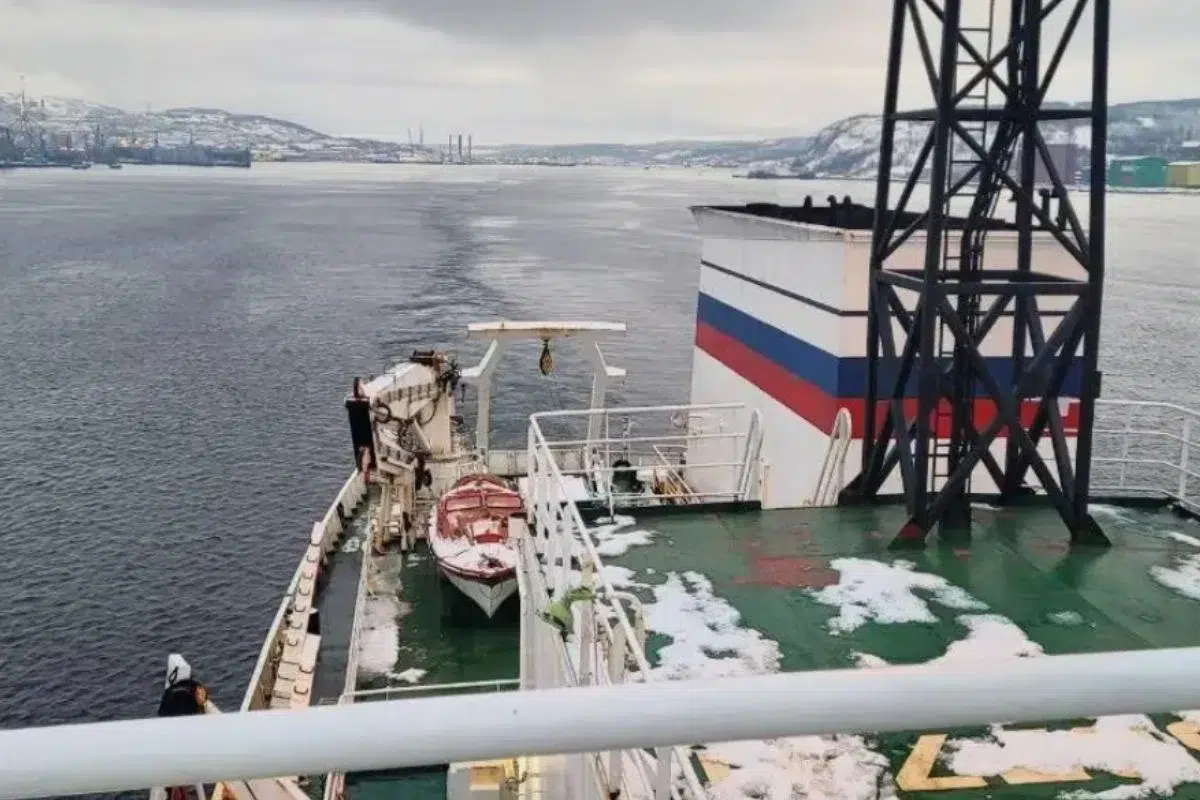
When oceanographers scan the Arctic’s murky depths, they’re essentially reading through chapters of Soviet naval history that were never properly written down. This became strikingly clear when Russian researchers aboard the Akademik Ioffe stumbled upon something that shouldn’t have been lost : a radioactive waste disposal site that appeared on no public map, documented in no accessible archive, yet very much present beneath the Barents Sea’s grey surface.
The discovery happened during late 2025, part of a broader Arctic rehabilitation program designed to locate and assess submerged objects containing spent nuclear fuel. What makes this finding particularly noteworthy isn’t just what they found, but what they didn’t find beforehand—any official record of its existence. The site sits in the Bay of Currents, a region where disposal operations occurred throughout the 1980s, when industrial urgency typically overshadowed meticulous record-keeping.
Tracking down phantom nuclear vessels
The research vessel’s primary target bore the designation Likhter-4, a barge deliberately sunk in 1988 carrying a cargo few would envy. Inside its hull rested 146 containers of solid radioactive waste from submarine reactor operations, plus two reactor vessels from the K-22 submarine, lead-encapsulated and stripped of fuel. Coordinates existed on paper, yet previous expeditions in 2007, 2023, and 2024 aboard the Akademik Mstislav Keldysh had returned empty-handed. Arctic weather patterns proved uncooperative, limiting search windows.
This time, favorable conditions allowed the deployment of specialized remotely operated vehicles : GNOM “X”, GNOM “Vector”, and Argus. These weren’t simple underwater cameras but sophisticated platforms equipped with gamma spectrometers developed by the Kurchatov Institute, capable of detecting radiological signatures near submerged structures. The bathymetric analysis revealed an unexpected twist—Likhter-4 wasn’t resting near Roze Glacier as archives suggested. Instead, it had slipped into a natural depression exceeding 100 meters depth, settling far from its presumed location.
ScienceThe cleanest country on the planet has no trash cans on its streetsSimultaneously, the expedition achieved metric-level precision in locating the Nikel barge off Kolguev Island. This vessel holds approximately 580 tons of solid radioactive materials. While its general vicinity was known, previous positioning remained accurate only within several hundred meters. Twenty years since the last serious confirmation, researchers can now pinpoint its exact coordinates—a seemingly minor detail that fundamentally changes long-term monitoring capabilities.
The K-27 enigma and its liquid metal legacy
Among Arctic nuclear artifacts, submarine K-27 occupies a unique status. This experimental vessel, scuttled in 1981 near Novaya Zemlya’s Stepovoy Bay, carried two reactors using liquid metal coolant—a lead-bismuth alloy representing abandoned Soviet technology. Following a 1968 accident, the submarine languished for thirteen years before being deliberately sunk with its nuclear fuel aboard. Many specialists consider it among the most sensitive objects ever submerged in global oceans.
The Akademik Ioffe team conducted a comprehensive site inspection, combining advanced imaging with radiological measurements. Their findings paint a surprisingly stable picture :
| Measurement parameter | Observed status | Environmental impact |
|---|---|---|
| Containment barriers | Functionally intact | No active leakage detected |
| Cesium-137 presence | Surface hull contamination | No transfer to water/sediments |
| Reactor compartments | Sealed condition maintained | Minimal radiological influence |
Data gathered by the REM-4-50 spectrometer mounted on submersibles indicates that confinement structures continue performing their intended function. Cesium-137 signatures traced back to hull surface contamination rather than active environmental release. Specialists determined that the bay’s radiological conditions are more significantly influenced by other submerged containers than by K-27 itself.
From discovery to continuous surveillance
Based on these assessments, scientific authorities identified a coastal zone for installing permanent underwater monitoring stations. These facilities will measure radioactivity continuously, eliminating dependence on brief weather windows that currently limit Arctic research expeditions. The stations represent a shift from periodic surveys to constant vigilance, addressing gaps in our understanding of how these submerged materials behave over decades.
The newly discovered disposal site’s absence from official records raises uncomfortable questions about what else might be missing from Soviet-era documentation. When industrial operations prioritized immediate objectives over systematic record-keeping, the result becomes clear decades later : hazardous materials whose locations exist somewhere between rumor and fact. Researchers confront not just technical challenges of deep-sea exploration but archival archaeology, piecing together operational histories from incomplete fragments.
Key achievements from the expedition include :
- Precise cartographic mapping of previously “approximate” waste disposal coordinates
- Radiological baseline establishment for ongoing comparison studies
- Verification that current containment systems maintain structural integrity
- Identification of optimal locations for autonomous monitoring infrastructure
This meticulous documentation work lacks the dramatic appeal of breaking news, yet it addresses something more fundamental—regaining control over twentieth-century nuclear legacy. The Arctic shouldn’t remain a corroded vault filled with hastily made decisions from another era.
Reducing uncertainty beneath polar waters
Each located site, every mapped wreck, and all repeated measurements chip away at uncertainty surrounding Cold War nuclear operations. The Barents Sea keeps its secrets poorly now that technology enables thorough investigation of depths once considered effectively inaccessible. What distinguishes this work from previous attempts isn’t revolutionary equipment but patient, systematic application of existing tools during favorable conditions.
ScienceThis Austrian giant, standing at 570 feet, will be the first tower in Europe to feature this major innovation: an integrated photovoltaic facade.The Likhter-4’s actual resting place diverges significantly from archival coordinates—a reminder that historical documentation reflects intentions rather than outcomes. Objects settle where physics dictates, not where paperwork suggests. This reality underscores why verification through direct observation remains irreplaceable despite advances in modeling and prediction.
Moving forward, the permanent monitoring stations will generate continuous data streams, revealing seasonal patterns and long-term trends invisible to sporadic expeditions. This approach transforms nuclear waste management from reactive crisis response into proactive environmental stewardship, acknowledging that these materials will require attention spanning multiple human generations.
