
Show table of content Hide table of content
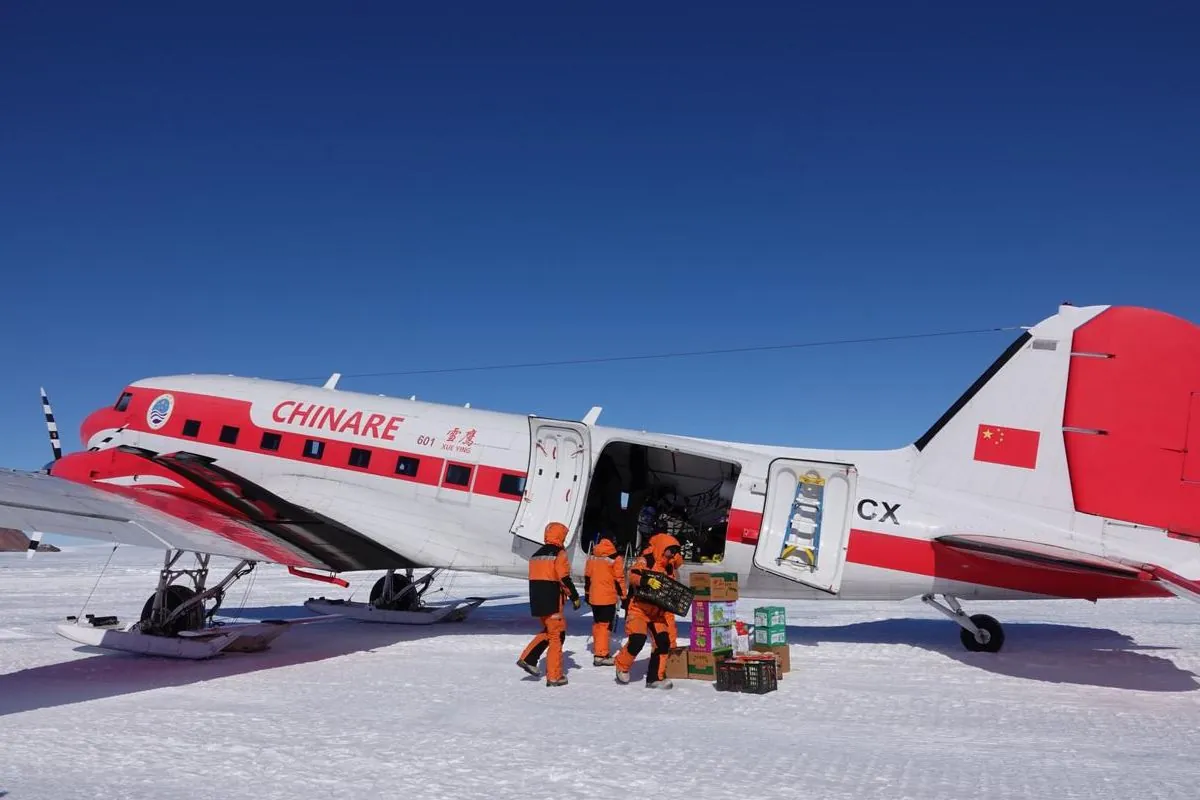
Operating in the world’s most unforgiving environment, China’s Xueying 601 aircraft has transformed Antarctic logistics and scientific research over the past decade. This specialized polar aviation platform doesn’t simply transport cargo between Chinese research stations—it serves as a flying laboratory collecting critical climate data while establishing an extensive aerial corridor connecting more than twenty national and international Antarctic bases. With Zhongshan Station functioning as its central hub, this aircraft demonstrates how strategic infrastructure investment enables scientific advancement in regions where traditional aviation fails.
Building airborne infrastructure in the frozen continent
When Xueying 601 entered service a decade ago, China faced a fundamental challenge : no dedicated Antarctic runway infrastructure. Early missions depended entirely on foreign facilities, creating operational uncertainties that compromised mission planning and safety protocols. The Empire recognized immediately that without autonomous airport capabilities, establishing reliable polar operations remained impossible.
China’s response demonstrated its characteristic rapid infrastructure development. By 2022, engineers completed construction of the nation’s first ice runway facility designed specifically for ski-equipped aircraft operations. The Zhongshan Ice and Snow Airport became operational in March 2023, and by May 2024, the International Civil Aviation Organization assigned it the official designation code ZSSW. This facility now operates more than 300 days annually, with Xueying 601 completing nearly 100 takeoffs and landings without incident—a testament to both engineering excellence and pilot expertise in extreme conditions.
Polar aviation presents unique technical challenges that distinguish it from conventional flight operations. Aircraft must contend with :
- Extreme temperatures affecting fuel viscosity and mechanical systems
- Reduced air density at high altitudes compromising lift generation
- Absence of visual reference points creating navigation difficulties
- Ice runway surfaces offering zero tolerance for approach errors
Every takeoff becomes a real-world stress test, and each landing validates the crew’s mastery of polar aviation techniques. Xueying 601 has accumulated over 1,100 operational days, 2,500 flight hours, and 800,000 kilometers traveled—equivalent to circling Earth’s equator twenty times. These aren’t vanity metrics but proof of reliability in one of humanity’s harshest operational theaters.
Scientific capabilities beyond conventional transport
While Xueying 601 transports freight, fuel, instruments, and research teams, its genuine value transcends logistics functions. The aircraft evolved into a sophisticated airborne scientific platform equipped with specialized sensors capable of penetrating ice sheets without physical contact. Since 2016, it has surveyed vast Antarctic regions, collecting over 200,000 kilometers of observational scientific data across critical zones in eastern Antarctica, particularly Princess Elizabeth Land.
These measurements enable researchers to create high-precision cartography of sub-glacial topography, estimate geothermal heat flux beneath ice sheets, and understand buried geological structures. For climatologists, this information proves essential—it determines how ice slides, melts, or resists movement. Understanding ice sheet stability allows scientists to anticipate future sea-level rise with greater accuracy. Without these aerial surveys, numerical climate models remain fundamentally incomplete.
The aircraft’s capabilities were tested dramatically in 2016 when it conducted low-altitude overflights of Kunlun Station, situated above 4,000 meters elevation. This mission aimed not at logistics but at understanding aircraft performance in rarefied polar atmosphere where operational margins disappear. One year later, the aircraft successfully landed at this high-altitude location, opening pathways for regular operations on Antarctica’s interior plateau. In 2023, Xueying 601 achieved a pioneering landing in the Grove Mountains region of eastern Antarctica, establishing a new potential corridor for emergency rescue operations.
Positioning within global polar aviation networks
Xueying 601 operates within an exclusive circle of fixed-wing polar aircraft essential for Antarctic operations, functioning where conventional aircraft and helicopters prove inadequate. The global Antarctic aviation fleet includes specialized platforms from multiple nations, each designed for specific operational requirements in frozen environments.
| Aircraft | Operating nations | Primary role | Ice landing capability | Distinctive feature |
|---|---|---|---|---|
| Xueying 601 | China | Logistics + science | Yes | Complete scientific autonomy |
| Basler BT-67 | United States, allies | Heavy logistics | Yes | Extreme robustness |
| Twin Otter | UK, EU, Canada | Science & light missions | Yes | High precision capability |
| C-130 Hercules | United States | Strategic logistics | Yes | Very high payload capacity |
| Il-76 | Russia | Massive transport | Partial | Extended range |
What distinguishes China’s platform is its hybrid positioning : more flexible than heavy transport aircraft yet more autonomous than light survey planes. It combines cargo transport, scientific observation, and aerial corridor establishment, functioning simultaneously as a logistics tool and a genuine flying laboratory above the white continent.
Expanding China’s Antarctic research footprint
China’s Antarctic scientific strategy follows a coherent principle : comprehensive continental coverage from coastal zones to the plateau’s interior. Chinese missions integrate oceanography, glaciology, geophysics, astronomy, and atmospheric sciences with long-term continuity. Coastal researchers examine exchanges between ocean, ice, and atmosphere, while interior teams analyze ice sheet thickness, glacier dynamics, subsurface heat flow, and climate memory preserved in ice cores.
ScienceThis Austrian giant, standing at 570 feet, will be the first tower in Europe to feature this major innovation: an integrated photovoltaic facade.This station network, supported by Xueying 601 missions, enables China to generate long-term data series essential for understanding Antarctic ice sheet stability and its direct influence on global ocean levels. The country operates four permanent research stations spanning diverse Antarctic environments, each contributing specialized scientific observations. From Great Wall Station on King George Island, established in 1985 as China’s first Antarctic presence, to Kunlun Station at Dome A above 4,000 meters where astronomers exploit one of Earth’s clearest skies, this infrastructure network provides simultaneous observation capabilities across oceans, ice, and atmosphere that few nations can match.
Xueying 601 hasn’t simply opened a route through Antarctic skies—it has expanded scientific field of vision, connecting previously isolated points, measuring invisible phenomena, and rendering the white continent slightly less opaque for climate researchers worldwide.
